
The Great Pivot: Navigating the Economic Turbulence of Modern VFX
For decades, the visual effects (VFX) industry has operated under a strange paradox: as the demand for "spectacle" in cinema and television reaches an all-time high, the studios responsible for creating that magic often find themselves on the brink of financial instability. If you’ve followed industry news over the last 24 months, you know this isn't just a rough patch—it’s a systemic restructuring. From the "post-peak TV" slump to the aggressive integration of Generative AI, the VFX landscape is undergoing a seismic shift in both economics and labor.
VFX
Staff
5/13/20263 min read

The Economic Squeeze: A "Post-Peak" Hangover
The industry is currently reeling from a perfect storm of economic pressures. Following the 2023 Hollywood strikes (WGA and SAG-AFTRA), the production pipeline didn't just slow down; it cratered. Recent data indicates a staggering 40% decline in US film and television production throughout 2024, contributing to a global contraction that has left many studios fighting for survival.
But the problem isn’t just a lack of work—it’s the structure of how that work is billed. The industry has long relied on "fixed-bid" contracts. In this model, a studio agrees to a set price for a project. If the client (the studio or streamer) requests ten rounds of changes—which they almost always do—the VFX house absorbs those costs. This creates an environment where "success" often looks like extreme overtime and shrinking profit margins, leading to the precarious financial state that has claimed several legacy studios in recent years.
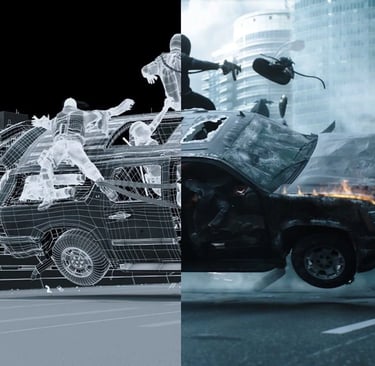
Wireframe and rendered view of VFX damage, courtesy of InFocus Film School
Labor Shifts: From Corporate Hubs to Digital Nomads
As large-scale studio stability wavers, the labor force is migrating. We are seeing three primary shifts in how VFX artists are working:
1. The Rise of the "Boutique" and Freelance Model
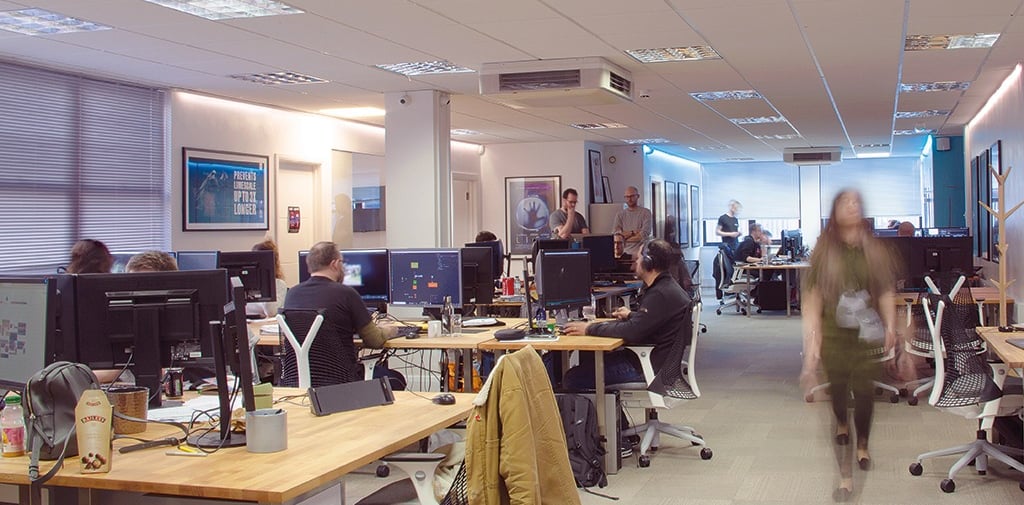
The era of the 500-person monolithic studio is being challenged by smaller, agile boutique shops. Many senior artists, exhausted by "crunch culture" and corporate instability, are moving toward independent contracting. By operating as freelancers, artists can diversify their client base, reducing the risk of a single project cancellation wiping out their income.
2. The Migration to Real-Time (Gaming)
There is a massive talent bleed from traditional VFX into the gaming sector. With the maturation of real-time engines like Unreal Engine 5, the line between "film" and "game" has blurred. Artists are realizing that the gaming industry generally offers more stable long-term employment and better pay than the project-to-project volatility of film production.
3. The Incentive Chase
Labor continues to follow tax credits. We've seen a massive shift toward Canada and Asia-Pacific hubs, where government incentives make it cheaper for major studios to house their pipelines. While this creates local booms, it often leads to "regional instability"—the moment a government changes its tax laws, thousands of jobs can vanish overnight as production moves across the border.
The AI Elephant in the Room
We cannot discuss labor shifts without mentioning Generative AI. For the VFX artist, AI is a double-edged sword. On one hand, it promises to automate the "grunt work"—the tedious rotoscoping and plate cleaning that once took weeks.
On the other hand, there is an existential fear that entry-level roles (Junior Artists) are being erased. If AI can handle the base layers of a shot, the traditional "ladder" for new artists to enter the industry and learn the craft is being dismantled. The economic instability is compounded by this: studios may see AI as a way to cut costs, but they risk destroying the talent pipeline that produces the Senior Leads of tomorrow.
Looking Forward: Adaptation as Survival
The VFX industry isn't dying, but it is evolving. The "old way"—centralized hubs, fixed-bid contracts, and unsustainable crunch—is no longer viable in a world of fluctuating production volumes.
For the artist, survival now means diversification. The most successful creators are those who can jump between traditional VFX, real-time environments, and AI-augmented workflows. For the studios, the path forward requires a move toward more transparent, flexible pricing models that value labor as a variable cost rather than a fixed one.
The spectacle will always be in demand; the question is whether the industry can build an economic foundation that is as robust as the images it creates.

Connect
Engaging storytelling through immersive media solutions.
contactus@lm3official.com
+1234567890
© 2026. All rights reserved.

services