
The Future of Open Source: 5 Game-Changing Features Coming to Blender 5.1
For years, the Blender community has lived by a simple mantra: “It’s getting better every single version.” But with the upcoming release of Blender 5.1, it feels like the developers aren't just making incremental improvements—they are fundamentally shifting the landscape of 3D production.
3D SOFTWARE
4/16/20262 min read
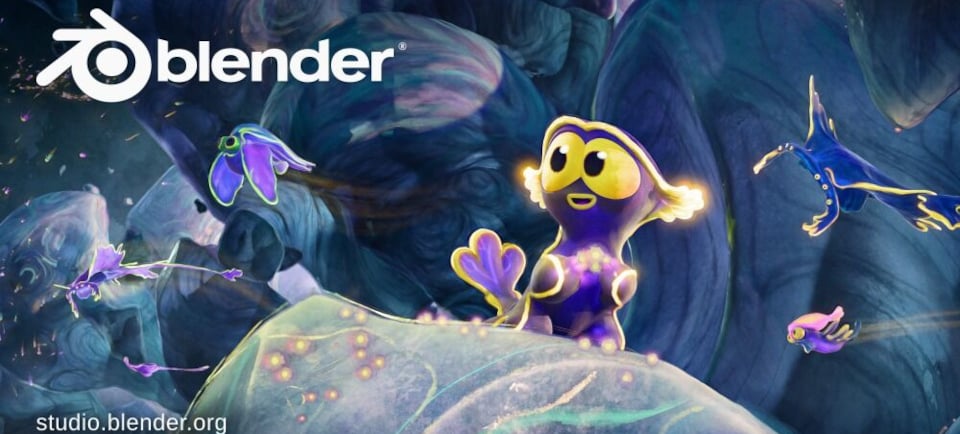
A recent deep dive by CG Channel has highlighted five key features that promise to bridge the gap between Blender and high-end proprietary software, making it a powerhouse for even the most demanding professional pipelines.
If you’ve been waiting for the "killer feature" that makes Blender your primary workstation, here is what you need to know about version 5.1.
1. Real-Time Neural Path Tracing (Cycles Next-Gen)
The biggest headline in 5.1 is the overhaul of the Cycles engine. By integrating dedicated neural denoising directly into the path-tracing kernel, Blender has achieved what many thought was years away: near-instantaneous viewport feedback.
Instead of waiting for samples to accumulate, the new "Neural Path Tracing" uses a lightweight AI model to predict light bounces in real-time. This allows artists to move lights and adjust materials with the fluidity of an Eevee-style engine, but with the photorealistic accuracy of a full path tracer.
2. The "Geometry Nodes 3.0" Workflow Revolution
Geometry Nodes have already transformed Blender into a procedural powerhouse, but version 5.1 introduces Node-Based Simulation Logic.
Previously, complex physics (like cloth or fluid) required jumping between different workspaces or using external solvers. In 5.1, you can now bake high-fidelity simulations directly within your Geometry Node trees. This means you can create a procedural forest where the wind affects the leaves, the branches bend, and the grass reacts—all controlled by a single node setup.
3. Unified USD (Universal Scene Description) Integration
For those working in large-scale studio environments, the "interoperability headache" is finally being addressed. Blender 5.1 introduces a native, high-speed USD pipeline.
This isn't just about importing files; it’s about live-linking. You can now work on a scene in Blender while simultaneously seeing updates from a collaborator working in Houdini or Maya via the USD stage. This makes Blender a much more viable option for massive, multi-user VFX pipelines.
4. AI-Assisted Retopology & UV Unwrapping
Let’s be honest: retopology and UV unwrapping are the "chore" phases of 3D modeling. Blender 5.1 tackles this head-on with Smart-Mesh AI.
With a single click, the software can analyze a high-poly sculpt and generate clean, animation-ready topology that respects edge loops and deformation zones. Similarly, the new UV tool uses machine learning to predict optimal seam placement, drastically reducing the time spent fighting with texture stretching.
5. Enhanced Sculpting: Dynamic Topology 2.0
Sculpting in Blender has always been intuitive, but it often lacked the "feel" of dedicated sculpting software like ZBrush. The 5.1 update introduces Dynamic Topology 2.0, which features much more sophisticated mesh density management and a new "Multi-Resolution Brush" that allows for incredibly fine detail without the massive memory overhead that previously plagued high-poly sculpts.
Final Thoughts: Is Blender Ready for the Big Leagues?
With the release of 5.1, the line between "open-source tool" and "industry standard" is becoming increasingly blurred. By focusing on AI integration, proceduralism, and professional pipeline compatibility (USD), the Blender Foundation is proving that they aren't just keeping up—they are setting the pace.
Connect
Engaging storytelling through immersive media solutions.
contactus@lm3official.com
+1234567890
© 2026. All rights reserved.

services